How to Create a 3D Line Distortion Effect (PhotoStitch)
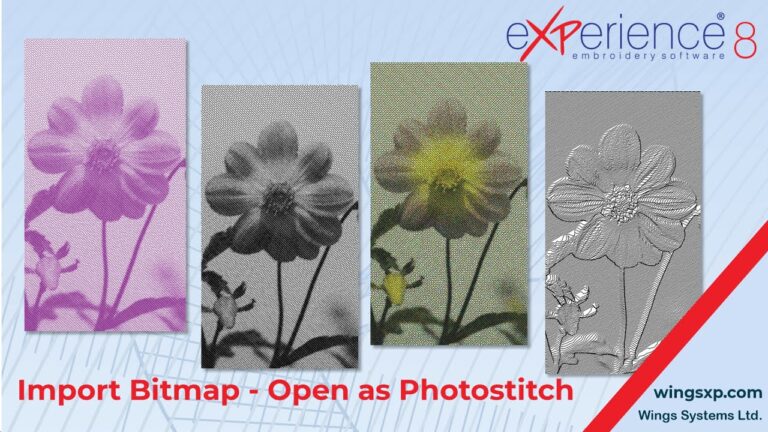
In eXPerience 8, you can transform standard bitmap images into captivating PhotoStitch designs that create a 3D illusion. By converting solid shapes or text into parallel Satin bars, you can add depth and movement to your embroidery.
This tutorial guides you through creating the artwork, importing it, and adjusting the parameters to achieve this stunning line distortion effect.

Step 1: Prepare the Artwork
You can use any bitmap image, but for the best results, we recommend creating a specific source file within the software first.
- Open a New file.
- Select the Text tool or create a shape.
- Example: Type a capital letter (e.g., “W”) using a thick font like Arial Black at a large size (e.g., Font size 100).
- The Golden Rule: Ensure you are working with solid monochrome objects against a contrasting background.
Saving the Artwork as an Image
Once your design is ready on the screen:
- Go to File > Print Artwork.
- In the Print dialog, select “Design only”.
- From the Printer dropdown menu, select “Save as JPG”.
- Save the file to your computer.
Tip: Thick, bold fonts and solid simple shapes work best for this technique as they provide enough surface area for the distortion effect to be visible.
Step 2: Import as PhotoStitch
Now that you have your source image, you need to bring it back into the software as a PhotoStitch object.
- Start a New design.
- Click the Import file icon.
- Locate the JPG file you just saved and click Open.
- In the dialog box that appears, set the Conversion Type to Open as PhotoStitch.
- Important: In the Preview window, select the area you want to import. Ensure you leave some empty background space around your object (do not crop it too tight), as the lines need space to “bend.”
- Click OK.
Step 3: Apply the Line Distortion (Height Style)
By default, the software may apply a standard fill. To create the 3D line effect:
- Select the imported design.
- Go to the Properties bar.
- Change the Style to Height.
You will see the design convert into parallel Satin bars. These bars distort along the outline edges of your shape, creating an elevated illusion.
Step 4: Adjusting Parameters
You can fine-tune the look of the distortion using the following settings in the Properties bar:
- Height: Controls the strength/intensity of the distortion.
- Range: 0.1 (subtle) to 6 (maximum depth).
- Adjust the slider to see live updates in the preview.
- Width: Sets the distance (density) between the Satin bars.
- The minimum value is 1. A lower number creates a fuller design; a higher number creates a more open, artistic look.
- Negative: Check this box to invert the effect. Instead of looking elevated, the object will appear to be pressed into the fabric (concave vs. convex).
Step 5: Controlling Stitch Direction
To change the angle of the lines:
- Select the Stitch Flow tool from the toolbar.
- Click and drag handles on the design to change the direction of the Satin bars.
- Experiment with different angles to see how light interacts with the 3D effect.
Step 6: Using Grid Style (Optional)
For a textured, cross-hatch look:
- With the object selected, change the Style in the Properties bar to Grid.
- This adds both horizontal and vertical Satin bars.
- Just like the Height style, you can adjust the Height, Width, and Stitch Flow to customize the mesh texture.
Advanced Tip: Using Blurred Images
You are not limited to sharp shapes created in the software. You can import external bitmap images as well.
- Try this: Import a blurred image using the “Open as PhotoStitch” method.
- The Result: A blurred source image creates a more organic result. The Satin bars will wrap smoothly around the design like waves, rather than having sharp, jagged breaks.
eXPerience Facebook Page
Happy crafting and don’t forget to share your creations with us in the
eXPerience Facebook Page!