How to Create Curved and Custom Text in eXPerience 8: Master Text Placement
Introduction
Text placement is a powerful feature in eXPerience 8 embroidery software that allows you to position text in creative ways to enhance your embroidery designs. This tutorial will guide you through the various text placement options and show you how to apply paths to text objects.

Basic Text Placement Options
Step 1: Understanding the Default Horizontal Placement
When you first add text to your design, it will use the “Horizontal” placement option by default. In this mode:
- Text flows in a standard left-to-right horizontal line
- You can move individual characters if needed
- This is the most basic text placement option
Step 2: Exploring Vertical Placement
To change text orientation to vertical:
- Select your text object
- Change the placement option to “Vertical”
- Your text will now be arranged in a vertical column
- You may need to adjust letter spacing and alignment to achieve your desired look
Working with Line Segment Placement
Step 3: Text Placement on a Line Segment
For text that follows a straight line:
- Select your text object
- Change the placement option to “On line segment”
- Your text will appear on a straight line with green handles at each end
- Use these handles to:
- Change the line’s position
- Adjust the angle
- Modify the length
Step 4: Adjusting Alignment on a Line Segment
When text is on a line segment, you can control its alignment:
- Select your text object
- Use the alignment options:
- Right
- Left
- Center
- Full
When using “Full” alignment, the letter spacing will automatically adjust if you change the line’s size.
Step 5: Using Offset on a Line Segment
To control where the text begins on the line:
- Select your text object
- Adjust the offset value
- Type your desired value and press Enter to apply it
- The text will shift its starting position along the line
Step 6: Changing Direction on a Line Segment
To reverse the direction of text flow:
- Select your text object
- Enable the “Reverse direction” option
- The text will now begin from the opposite end of the line
Step 7: Understanding Text Placement Relative to the Line
You can control how text sits in relation to the line:
- Select your text object
- Choose one of the “Text placement” options:
- Baseline: Letters are placed along the line, with descenders (like in letters g, j, p, q, y) going below
- Bottom: All letters sit on top of the line
- Ascent: Most letters go below the line, with ascenders possibly extending above
- Top: All letters are positioned below the line
Creating Text on an Arc
Step 8: Placing Text on an Arc
For text that follows a curved path:
- Select your text object
- Change the placement option to “On arc”
- Your text will appear on a curved arc with three control handles:
- One at the start of the arc
- One at the end of the arc
- One in the middle to control the radius
Step 9: Customizing Text on an Arc
When text is on an arc, you can:
- Move any of the three control handles to reshape the arc
- Use the same alignment options as with line segments
- Apply the same text placement options (Baseline, Bottom, Ascent, Top)
Advanced Text Placement Using Custom Paths
Step 10: Using the “On User Path” Option
For maximum flexibility with text paths:
- Select your text object
- Change the placement option to “On user path”
- You can move the text as is
- You can adjust alignment and placement options
Step 11: Editing a Custom Path
To modify a custom path:
- Select your text object
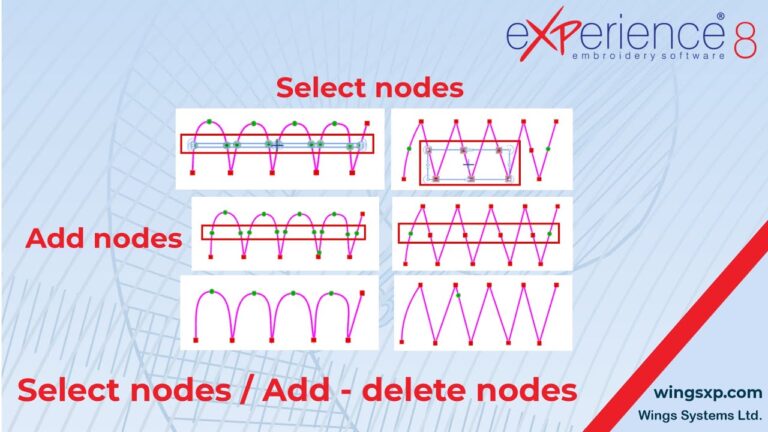
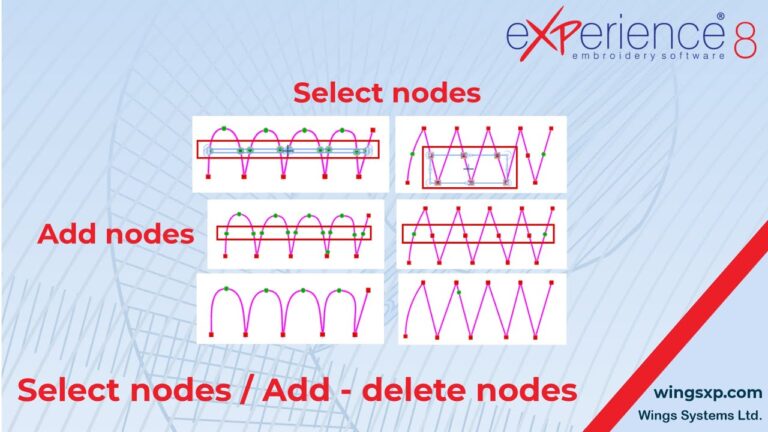
- Switch to “Edit nodes” mode
- Add or edit nodes as needed
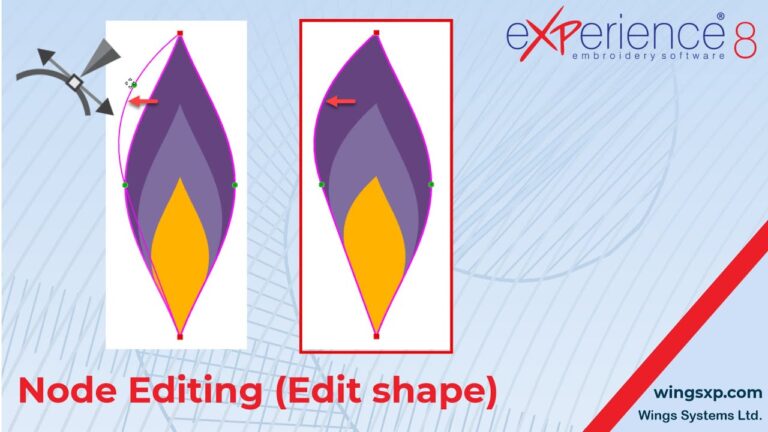
- Use all available node editing functions to customize the path
- This advanced technique allows for unique baseline effects
Step 12: Using Design Elements as Paths
You can use any part of your design as a text path:
- Select both the text object and the line element you want to use as a path
- Right-click and select “Apply path” from the menu
- The text will now follow the selected line
Step 13: Using an Ellipse as a Path
To place text along an elliptical path:
- Create an ellipse
- Select both your text and the ellipse
- Right-click and select “Apply path”
- Start the Text tool to adjust the placement on the ellipse
- You can later edit this path using the node editor if needed
Practical Example: Placing Text on Sail Shapes
Step 14: Preparing Sail Shapes for Text Paths
- Duplicate each sail shape you want to place text on
- Change the type of the duplicate to “Running”
- Scale it slightly larger to make selection easier
Step 15: Creating Custom Paths from Sail Shapes
- Use the node editor to split the sail outline
- Create the specific paths you want to use
- Use Break Apart to separate multiple paths
- Remove any unnecessary paths
Step 16: Applying Text to Sail Paths
- Select a text object and one of your prepared sail paths together
- Right-click and select “Apply path” from the menu
- The text will now follow the sail’s contour
- Repeat for any other text and path combinations
Step 17: Customizing Text on Your Paths
- With the text applied to the path, start the Text tool
- Edit the text content as needed
- Adjust any placement options to perfect the positioning
Step 18: Removing a Path When Needed
If you want to return to standard text placement:
- Select the text object
- Right-click and choose “Clear path”
- Your text will return to its default placement
Conclusion
The text placement options in eXPerience 8 embroidery software provide powerful tools for creative embroidery designs. By mastering these techniques, you can create professional-looking text that flows along any path or shape in your design. Experiment with different placement options to add unique artistic touches to your embroidery projects.
eXPerience Facebook Page
Happy crafting and don’t forget to share your creations with us in the
eXPerience Facebook Page!